Singapore's AI usage is getting out of hand
The short version
A 64-minute AI film is premiering on National Day, and it looks like slop. Half the estate banners this year got the flag wrong. Nobody is upset that AI made it. They are upset that nobody looked before it went up.
There is a 64-minute AI-generated film premiering on National Day, and it looks like slop. It is a science fiction film called Trace Project, set in the late 2030s while Earth’s ecosystem is collapsing, and it follows Singapore’s first astronaut on Mars. There is one screening only, 9 August at Golden Village VivoCity Hall 4, 2pm, and after that it is only on their app. People online have already called it AI slop, and I am not going to pretend that is unfair.
I use these tools. I generate videos for client work, and I have spent enough time in Higgsfield to know what the good end of this looks like. Those mini videos coming out of there look like high production work. The lighting holds when the camera moves. The face is still the same face after a cut. Things move the way things are supposed to move. Trace Project is nowhere close to that. It looks like whatever came out of the box on the first try.
The studio is FizzDragon, and they made this with around ten people across three countries. Their previous film had more than 130 creators across thirteen countries. Founder and CEO Pax Chen calls the smaller setup a “global creator ecosystem” and says the production method is “part of the story itself.”
I do not buy her answer to the slop comments
Chen said that “every new product inevitably faces criticism” and that it “is measured against the yardsticks of the old.” She went with cars, saying AI “freed the coachman’s hands.” Then there was this one. “Those who dismiss AI as ‘slop’ might do well to look at the scale of the AI creative economy worldwide today, the jobs it has generated and the opportunities it has unlocked.”
Yes, I get it. The AI creative economy is huge, the jobs are real, and nobody in the comments is disputing any of that. But nobody was talking about the economy. They were talking about the 64 minutes. If the tool is mature enough to have an entire industry sitting on top of it, then the work it makes is old enough to be judged like everything else, and you cannot keep asking people to grade it on a curve.
The posters this year have been rough
Two weeks before the film, the estates started putting up National Day banners, and things went badly. At Block 409 Bedok North Avenue 2, a banner went up with a Singapore flag that had no crescent and no stars on it, leaving just red and white, which is the flag of Indonesia. Another panel on the same banner had a building labelled Singapore National Indoor Stadium, which is not a place. An art practitioner called Zu spotted it on 19 July, and it came down that same evening.
Kampong Chai Chee Community Club said that the banner “was created and paid for by residents,” mostly seniors, and that they “were not aware that the AI-generated banner contained inaccuracies.” Then they said the sensible thing, that AI output “should always be carefully checked before it is used.”
I am not going to sit here and blame the aunties and uncles. They wanted to put something up for the country and they used the tool that was in front of them. That part is fine. What is not fine is that the thing got generated, sent to a printer, blown up to three metres and hung on the side of a block, and nowhere in that entire chain did anybody who knows what our flag looks like actually look at it.
A few days later, a second banner went round Reddit, this one in Pasir Ris. The crescent and stars were on the wrong side, facing the flagpole, and people were counting six fingers on the boy holding it. Everybody assumed AI. Pasir Ris-Changi Town Council took responsibility and said “AI image generation was not used at all throughout the creation and editing of the banner”. It was a resident’s real photo from a National Day contest, and somebody flipped the flag while editing it. So that one was a human mistake, and the whole internet still assumed AI, because that is the default assumption now.
The comments were not gentle either. “Why are so many NDP decorations all AI now? I think I’ve already seen like three clearly AI-generated decorations and it feels strangely insulting,” one person wrote. Someone else just said, “This AI rubbish makes us look broke.”
Nobody is upset that a machine made it. They are upset that nobody bothered to look at it before it went up.
Our arts scene could not take this year
The arts scene here was already struggling long before any of this. It is a small market with small budgets, and there has always been an attitude that design is the thing you sort out at the end, after the real work is done. The Illustration Arts Festival in July had to brand itself “100% HUMAN” this year. It had 260 artists from 16 countries and was sold as a sanctuary. When a festival has to advertise that people made the work, that tells you enough about how the people who do this for a living are feeling.
And this is the part that actually worries me. If grassroots bodies and government-adjacent organisations start putting out generated work, that becomes the standard everybody else measures against. Once a National Day banner can be generated and printed at public expense, every company here has something to point at the next time somebody asks why the design budget got cut. Others will follow suit. Nobody has to announce it. It just becomes the normal way of doing things, and then the designers we do have are left with nothing.
The small guy I get. The big brands I do not.
I understand the small business side of it. A small restaurant running on thin margins never had a designer and was never going to hire one. Their poster before this was Comic Sans over a photo taken with the flash on, printed at the shop downstairs. Now they can put out something with spacing and readable type. That is a genuine improvement, and I am not going to act superior about it.
But let’s be real. The images are not real. The moment the plate of food on your poster is not the plate of food you actually serve, you have not made a nicer poster. You have made an advertisement that lies about the exact thing the customer is paying for. Just shoot your own char kway teow on your phone next to a window. People can tell the difference, and once they can tell, it stops reading as low budget and starts reading as dishonest.
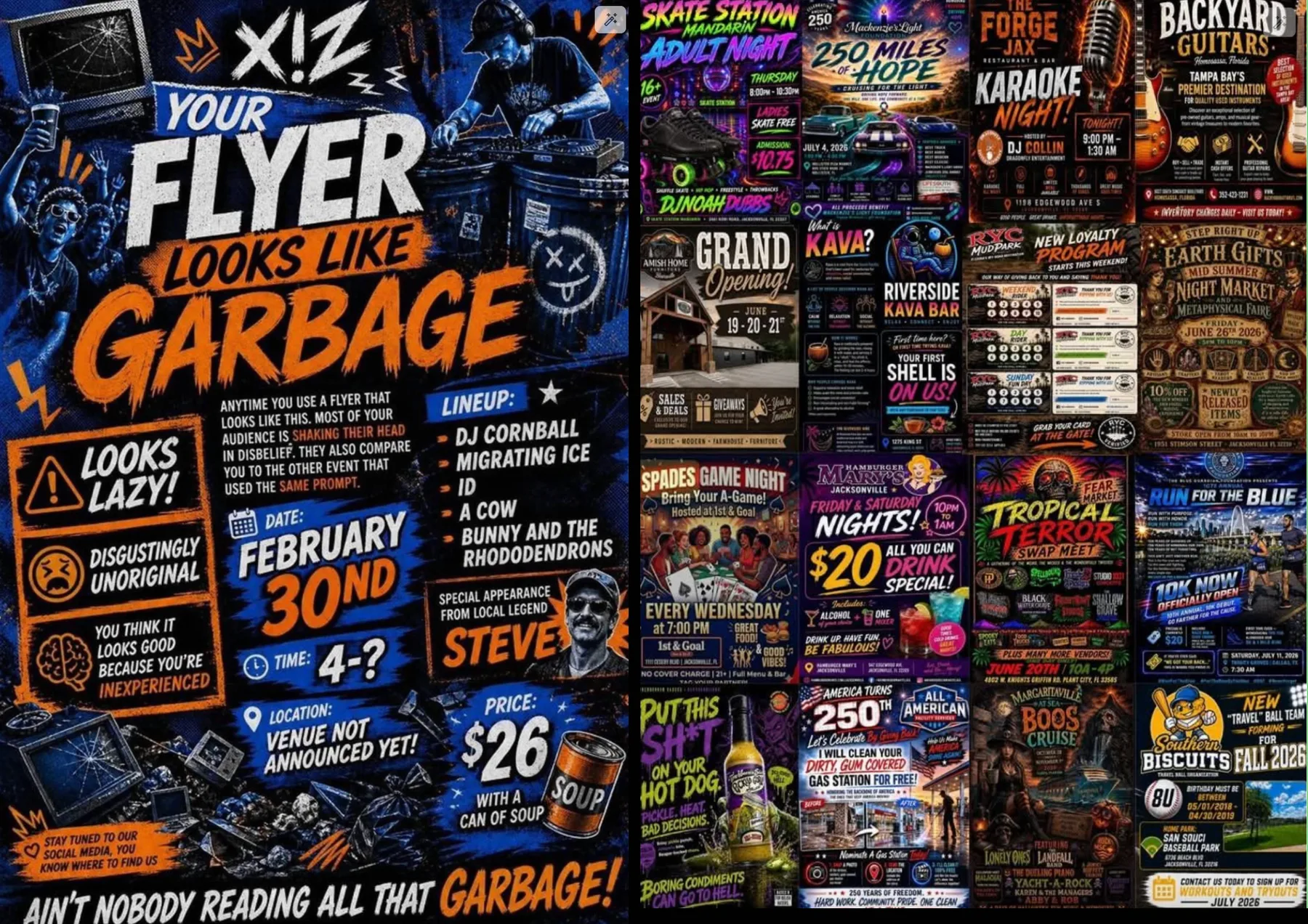
The big brands are where it actually gets to me. These are companies with agencies on retainer and brand guidelines that run for pages. When one of them still puts out a poster with warped hands, melted signage and text that turns into symbols halfway through a word, it is honestly disgusting to me. It is done so distastefully. And it works on me in completely the wrong direction, because I see it and I do not want to buy the product any more, which is a strange result for a marketing budget to achieve.
So here is the line I hold on client work. Take it if it is useful. Generate the things nobody is paying for: backgrounds, textures, mood boards, the fifteen bad layouts you throw away before you find the good one. Do not generate the product, do not generate the people, and do not generate the flag. For everything past that line, pay someone, not because craft is sacred but because paying someone is how you end up with an actual human who notices that the stars are on the wrong side before it goes to print.
Mothership’s writeup on the film is here, and their report on the Bedok banners is here. Fair warning, the comments under both are more useful than either article.